
Despite what you may have been led to believe, it is possible to reclaim professional fees incurred from your own appointed subsidence expert (be that a structural engineer, building surveyor or other relevant professional) under your buildings insurance.
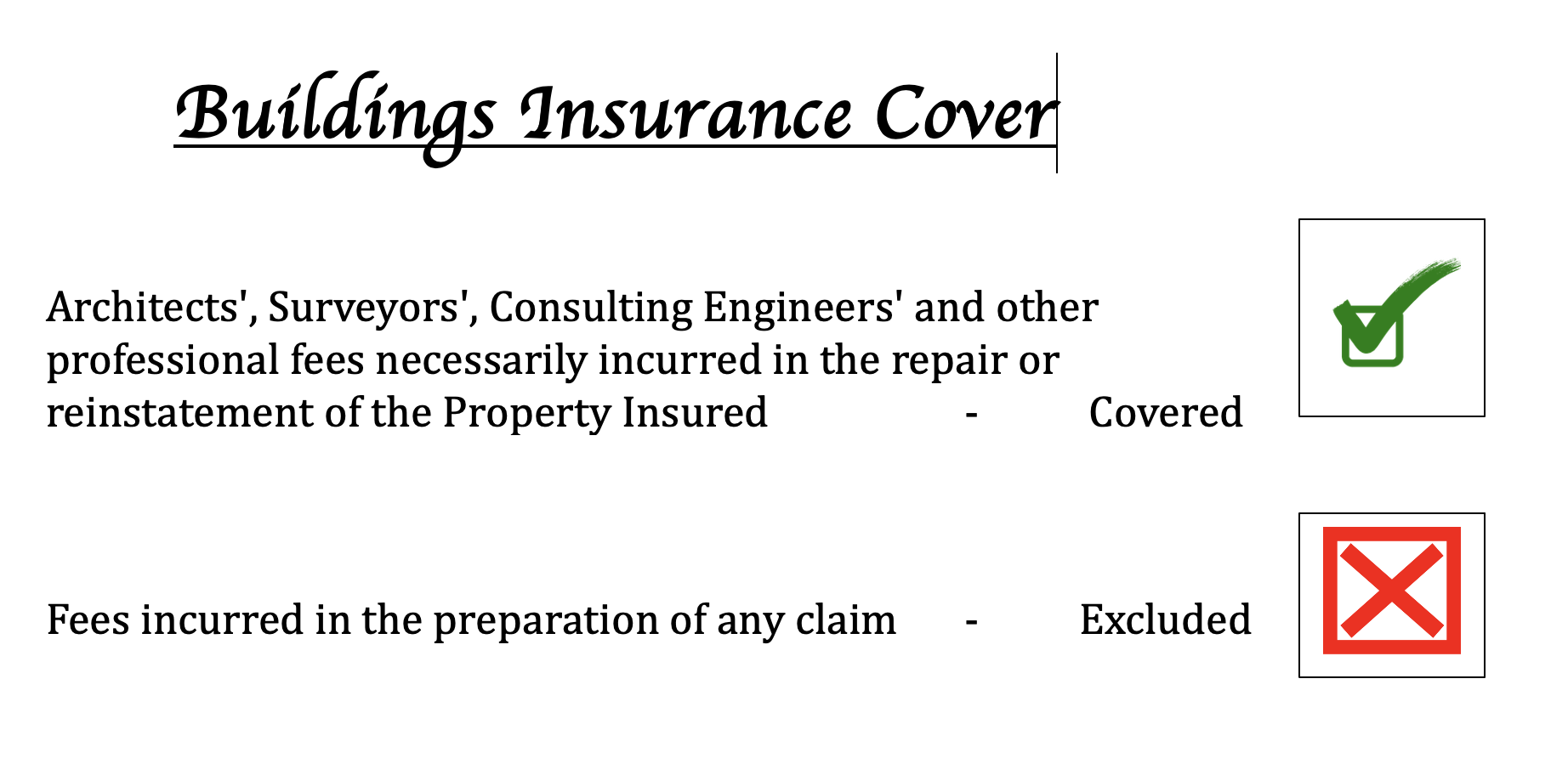
Almost without exception, buildings insurance covers professional fees necessarily incurred in the repair and reinstatement of your buildings after insured damage. Traditionally this was worded as “Architects’ and Surveyors’ fees” but this also covers structural engineers – as long as it is necessarily incurred. It is universally accepted throughout the insurance industry that an appropriate expert is necessary in diagnosing subsidence, carrying out site investigations to identify the cause, and obtaining sufficient technical evidence to get it resolved. This often includes a lengthy period of structural monitoring as well. Sometimes also in the design, specification and administration of the repair scheme (on the larger more involved cases).
In the early days of subsidence insurance claims (the 1980s & ‘90s) it was commonly accepted that the client would appoint their own expert (often a structural engineer back then) to handle this and insurers would willingly reimburse customers for that. However since the ‘90s, firms of loss adjusters have been employing their own in-house experts to deal with this. Nowadays this is the norm, and insurers & loss adjusters usually resist any suggestion that the insurer should pay for the customer’s own chosen consultant instead. Many customers are perfectly happy to allow their insurers’ appointed experts to handle the problem, but some understandably want to retain their own chosen expert who is completely independent from the insurer or loss adjuster. The insurer will often (at first) not agree to reimburse the customer the cost of that consultant, which has given rise to a number of complaints to the Financial Ombudsman service (FO).
In some (few) cases, the policy wording specifically excludes fees which have been incurred without the insurer’s prior consent. If your policy has such a wording then you will need to seek that consent first to have any hope of reclaiming your consultant’s fees. Insurers will generally resist giving such consent – but can often be persuaded with a good technical argument as to why this is necessary. Impartiality and independence from the insurer / loss adjuster is not generally considered a good enough reason – loss adjusters should act completely impartially anyway, though in many cases true impartiality is hard to see. Loss adjusters rely heavily on contracts with insurers for large quantities of work, and cost-saving is often a big factor in the insurer’s decision of which adjusting firm to give the lucrative contract to. Adjusters invariably have this in mind when making decisions on claims. Some routinely skip site investigations for example to keep costs down. The FO rightly considers site investigations to be an important ingredient in resolving subsidence which should be carried out routinely.
In most policy wordings, a requirement for the insurer’s prior consent is absent, so you can seek to reclaim costs you have incurred necessarily in advancing the diagnosis and investigation of your subsidence problem. Insurers still often resist paying for this, but in the absence of the prior consent exclusion, they need to successfully argue that the involvement of your consultant was not necessary. The onus is on the customer to demonstrate that the fees were reasonable and necessarily incurred and this often results in disagreement between customer and insurer.
Fees incurred before contacting an insurer: If a customer incurs an independent consultant’s fees before reporting the matter to the insurer, the insurer can (sometimes) argue that that was not necessary, because if the client had gone to the insurer first, the insurer would have used their own in-house expert or loss adjuster instead. However, many insurers (when a possible claim is reported to them) will ask the customer to obtain their own report on the matter first – in order to demonstrate the operation of an insured peril. If you can demonstrate that this was your insurer’s usual procedure, then you can argue that the fees were necessarily incurred – as had you reported it to the insurer first you would have been asked to get your own report.
Fees incurred at the insurer’s request for you to obtain your own report; This is a common request from an insurer when you first contact them to report a possible claim. However, the Financial Ombudsman is critical of insurers who adopt this procedure as it is the insurer’s responsibility to investigate a claim and decide whether it falls under the policy or not. Some insurers advise you (rather than require you) to get your own report first, on the basis that if they record a subsidence claim it could affect future premiums or cover.
Nevertheless, if you obtain your own report and it confirms the cause is likely to be subsidence then you should be able to recover the cost of that report. If it confirms that the damage is not subsidence then you won’t be able to recover the cost, but if your insurer has logged the claim as subsidence then you should be able to get that changed by forwarding the report (confirming non-subsidence) and requesting the possible claim be removed from your insurance record. If the insurer won’t do that then you can make a complaint to the FO – with a good chance of success.
A case such as this was heard by the Financial Ombudsman in 2020 (Mrs B v AA Underwriting Insurance Company) and the FO decided that the AA were acting unfairly in refusing to pay Mrs B’s engineer’s fees – which had confirmed the cause as subsidence.
Fees incurred because of dissatisfaction with the insurer’s expert. In some cases, homeowners choose to employ their own consultants because they are not happy with the way the insurer’s expert is handling matters. In such cases a complaint to the insurer (or ultimately the FO) often results in agreement to reimburse reasonable consultants’ fees incurred by the customer in getting the right work done. Such cases can include;
- Where site investigations have been skipped or were inadequate
- Where monitoring was absent or insufficient
- Where diagnosis of the cause is incorrect
- Where assessment of required repairs is inadequate
- Where mitigation measures (such as tree removal) are insufficient to resolve the subsidence
- Where matters are not progressed swiftly enough
- Where the relationship between the homeowner and the loss adjuster has broken down
Th FO considers that in cases where the insurer’s expert has failed to deal with matters promptly and sufficiently, it is generally fair for the insurer to pay for the customer’s appointed expert instead – in getting matters back on track at least.
The key factor is reasonableness – was it reasonable for the homeowner to appoint their own expert? Obviously this is a matter often in dispute between policyholder and insurer but the FO has mostly supported the consumer in such cases. They have relatively high expectations as to how adjusters should conduct subsidence claims and are critical of corner-cutting to save costs. Here are links to some such cases;
- Mr & Mrs L v Admiral Insurance: In Decision DRN-3460911, Admiral was ordered to reimburse the costs of a private structural engineer’s report (plus 8% interest) after failing to handle the claim fairly initially.
- Mrs B v AA Underwriting: In Decision DRN-4154877, the insurer was required to reimburse the cost of a 2019 engineer’s report because they failed to properly investigate ongoing movement.
- Mrs M v Aviva: In Decision DRN7160707, Aviva was ordered to appoint an independent engineer jointly with the policyholder to determine the cause of movement.
- Mr T v Allianz: In Decision DRN-0045666, Allianz was ordered to reimburse the costs of two private structural engineer’s report (plus 8% interest) after failing to handle the claim fairly initially. It was also asked to select 3 independent structural engineers for the customer to choose from going forward to achieve a permanent solution.
- Mrs H v HDI Global: In Decision DRN-2511341, HDI were required to reimburse Mrs H’s engineers fees when their loss adjusters were taking too long to get the subsidence resolved (6 years) so an engineered solution was necessary – as avised by Mrs H’s engineer.
Some cases where the FO found the insurer was acting fairly in refusing to pay independent consultants’ fees are summarised below;
- Mr E v Evolution: In Decision DRN-4652276, the FOS did not uphold a complaint for engineer fees because the policyholder hired their own engineer without consent, and the findings did not ultimately support a subsidence diagnosis.
- Mr S v Allianz: In Decision DRN-4002350, The Ombudsman declined to require reimbursement for an engineer’s report because it was inconclusiveand did not change the insurer’s position that there was no continuing subsidence.
- Mr & Mrs K v Lloyds: In Decision DRN-5629727, The complaint was not upheld because the policyholders did not give the insurer the opportunity to investigate the subsidence allegation before carrying out their own works and hiring experts.
Exclusion of fees for preparing claims; The professional fees clause invariably excludes the cost of “preparing a claim”, but what does that actually mean? Public Loss assessors exist for the preparation and presentation of claims (on behalf of home-owners) to their insurers. Assessors don’t usually deal with subsidence claims (because the reinstatement of damage is usually handled by a subsidence expert who’s costs are covered), but they can be very useful in extensive fires, floods or burglaries where the assessment of the loss covered under the policy can be a very time-consuming exercise, and one that someone who has just suffered a devastating loss really can’t face. This is the sort of thing that is intended by the above exclusion in the professional fees clause – not the cost of a subsidence expert acting for the homeowner in determining the cause of the subsidence and the type of mitigation and repair necessary.
Bob Gibson – Subsidence Consultant (structural engineer & building surveyor)